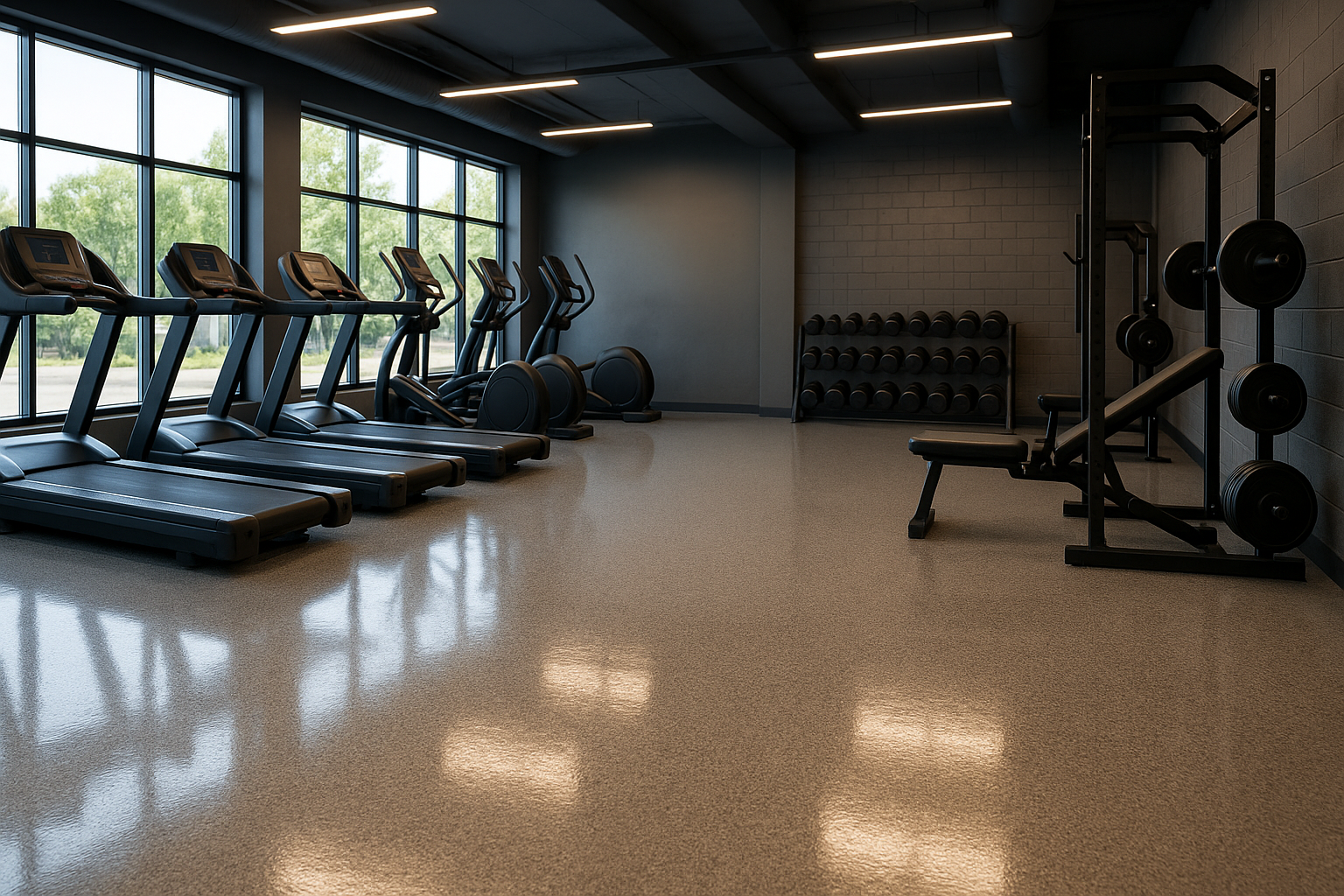
Floors carry the whole vibe of a gym—how it looks, how it sounds, and how it runs when the place is packed at 6 a.m. And if you’re running a fitness center around Salt Lake City, you’re also wrestling with snow, salt, grit, and a crowd that doesn’t exactly baby the ground under their feet. That’s why so many owners are turning to epoxy floors for fitness centers. They’re tough, good-looking, and easy to clean, which checks the boxes for both the workout crowd and your operations crew. Let me explain—and yes, we’ll get into color, logos, traction, and weekend installs that keep classes rolling.
Why gym floors in Salt Lake take a beating (and what to do about it)
Here’s the thing: Wasatch winters bring melt-off and magnesium chloride that track straight through your lobby. Summer dust sneaks in after hikes in Millcreek. Add sled pushes, kettlebell drops, chalk, sweat, and the occasional pre-work coffee spill—your floor gets a full workout too.
An ordinary painted concrete slab chips and powders. Rubber tiles flex and help in lifting zones, but seams catch dirt and moisture. Meanwhile, Salt Lake City epoxy flooring creates a sealed, continuous surface that resists abrasion and stain—no grout lines, no weird transitions, no surprises when the snow flies.
What epoxy flooring actually is (without the jargon-y lecture)
Think of a commercial epoxy system like a layered shield for your concrete. We mechanically grind the slab to open its pores. A primer soaks in and grabs on. A build coat adds body and strength. Then we lock it in with a wear layer—a urethane topcoat or polyaspartic topcoat—that fights scratches, UV, and chemicals. Want texture and color? We can “broadcast” vinyl flakes or Quartz sand into the floor and seal it smooth. It ends up looking like stone—but cleans like a dream.
Short version: a seamless, non-porous, slip-resistant epoxy surface that laughs at chalk, sweat, and road salt.
Durability that moves as fast as your members
Honestly, we’re picky about performance. A quality commercial epoxy coating handles heavy equipment footprints, rolling loads, and the micro-abrasion you get from constant foot traffic. Good coatings have high compressive strength; they won’t crater under loaded squat racks. And the topcoat matters: urethane and polyaspartic resist scuffs better than plain epoxy and hold color under UV from those big front windows.
You know what? Epoxy can handle more than most people expect. It resists sweat, sanitizers, sports drinks, and cleaning chemicals. It stands up to salt and winter moisture—especially when we prep and include moisture mitigation where the slab needs it. Reliability isn’t flashy, but it’s what keeps your doors open.
Safety first: traction, hygiene, and that just-clean feel
Gyms see wet shoes, sweaty palms, and sometimes foam rolling right after a water break. We tune the texture to fit the space. A broadcast quartz system in locker corridors boosts traction. A Flake system in the lobby balances slip resistance with that polished, welcoming look. Need a little more grip around water fountains? We’ll bump the grit there and ease it back on studio floors so it still feels smooth during bear crawls.
Because the surface is seamless and non-porous, dirt has fewer places to hide. No seams catching grime. No stained grout lines. It also cleans fast, which means you can mop between classes and not fight sticky spots later.
Style that matches your brand (and keeps members excited)
Let’s talk looks. Epoxy floors for fitness centers come in Colors that punch up your logo, subtle speckled blends that hide dust, and even Metallic epoxy swirls for a studio that wants a boutique vibe. We can lay down crisp lines for agility ladders, mark sled lanes, or inlay your emblem right under the squat rig. Want a softer visual in yoga rooms and a louder statement in the lobby? Easy.
Smart Finishes for real gym zones
| Solid #ccc;”>Area | Common Challenge | Epoxy Solution |
|---|---|---|
| Lobby and Check-in | Salt, coffee, first impressions | Flake system with satin urethane topcoat for style and scratch resistance |
| Strength Area | Scuffs, bench movement, chalk | High-build epoxy + polyaspartic topcoat; rubber mats at drop zones |
| Locker Rooms / Hallways | Wet traffic, cleaning frequency | Broadcast quartz for grip, easy sanitizing, and durability |
We’ll map your floor like a training plan—each zone tailored, but visually cohesive so members feel the flow.
But wait, doesn’t epoxy feel hard? Yes—and that’s the point
Here’s a small contradiction. Epoxy is hard. It’s not a cushy mat. And yet, people often say the floor feels kinder because it’s flat, even, and snag-free. Movements are smoother. Carts roll better. Cleaning is easier. For heavy drop areas, we pair epoxy walkways with rubber insets or dedicated platforms. You get the precision of a seamless epoxy surface where you need it and impact absorption exactly where it counts.
It’s like training shoes and lifters—you wear the right gear for the right lift. Same logic for floors.
Installation without wrecking your class schedule
Nobody wants to cancel the Monday boot camp. We plan around your busiest hours and use quick-cure products when needed. Many Salt Lake City epoxy flooring projects happen over a weekend, in phases. We’ll grind one area while another stays open, then flip.
Typical flow goes like this: surface prep and patching, primer, body coat with color or flake, then the topcoat. Cure times vary by system and weather; with polyaspartic, light foot traffic can resume quickly—sometimes the next day. Winter installs? We can heat the space, balance humidity, and keep the schedule tight.
Cleaning made simple: what your staff actually does
Training floors shouldn’t need a chemistry degree. Keep it simple and consistent. A neutral pH cleaner, some warm water, and a microfiber or auto-scrubber do the trick. Skip harsh acids or super-strong degreasers—they’re overkill and can haze the finish.
- Daily: Dry dust mop or soft-bristle sweep after the morning rush; spot mop spills immediately.
- Several times a week: Auto-scrub or mop with a neutral pH cleaner; rinse with clean water.
- After winter storms: Rinse entry zones to remove salt; salt crystals are tiny sandpaper.
- Quarterly: Deeper clean; check floor guards on benches and sleds, replace worn pads.
One more small habit that pays off: put absorbent mats just inside the door during snow season. Less grit in means less wear out.
What drives cost—and how epoxy often saves money long-term
Budgets matter. Pricing depends on square footage, system build (flake, quartz, metallic, or solid color), number of coats, moisture mitigation needs, and how much prep the concrete needs. Removal of old tile, mastic, or failing paint will add time but protects the finished result.
- Size and layout: Open floor plans are more efficient than small rooms with tons of edges.
- Concrete condition: Cracks, spalls, and high moisture call for repairs or a moisture mitigation primer.
- System choice: Broadcast quartz and thick-build coatings cost more up front but often last longer in hard-use zones.
- Downtime needs: Faster-cure systems can reduce closure time, which saves revenue.
We won’t throw a darts-at-a-board Estimate at you here. That said, many commercial gym projects in our region fall within a competitive per-square-foot range compared to replacing worn rubber and repainting concrete every year or two. The math usually leans toward epoxy because it lasts longer and cleans faster—fewer replacements, fewer surprises.
The Utah Epoxy Coatings Process: clear, clean, and local
We’re based here, so we build floors with Utah’s climate in mind. Our crews use dust-controlled grinding and, when needed, shot blasting to get real adhesion. We’ll moisture-test the slab (think ASTM F2170 in-slab RH or F1869 MVER) so we can recommend the right primer. Corners get detailed. Drains get checked. We don’t rush prep; that’s where good floors are born.
After installation, we walk the floor with you, talk cleaning routines, and give you a simple care sheet your team can actually follow. If you want, we’ll swing by after a season change to make sure the finish is still shining and the texture feels right.
A quick “what-if” project snapshot
Picture a 6,500-square-foot training facility near Sugar House: open floor, sled lane, locker hallway, and a bright lobby. We’d likely phase over three to four days—grind and patch on day one, prime and body coat on day two, flake broadcast and scrape on day three, and a polyaspartic or urethane topcoat on the last day. Light foot traffic could be back fast, with equipment reset shortly after the final cure. The lobby might get a speckled flake blend that hides salt and dust, while the locker hall gets quartz for extra traction. Sled lane? A slightly more textured finish so it stays steady under load.
That’s not a promise, just a real-world picture of how it tends to go when everything lines up.
Common questions we hear—answered straight
Will it be slippery when wet? We tune the texture to your needs. Locker corridors usually get more grit; studio floors get smoother but still pass traction checks.
Can you put our logo in the floor? Absolutely. We can inlay graphics and color zones and then seal them under the topcoat so they last.
What about dropped weights? Epoxy shrugs off scuffs, but we still recommend dedicated rubber in heavy drop zones. That combo wins.
How long does it take? Many gyms wrap up over a long weekend. Bigger spaces or complex repairs may take longer; we’ll build a plan that fits your calendar.
How do we clean it? Neutral cleaner, water, and a mop or auto-scrubber. Quick, repeatable, and consistent.
Why this matters for your members and your brand
Members remember how your space feels. A clean, bright, seamless floor changes the energy—less “Warehouse,” more “professional training home.” It can reduce odors by sealing porous concrete. It makes the early morning hustle easier on your staff. And it keeps your brand color front and center, which is a subtle nudge that they chose the right place.
In short: durable where it counts, stylish where it speaks, and smooth everywhere it should be.
Ready to talk floors? We’ll keep it simple
If you’re planning a new gym or giving your current space a refresh anywhere along the Wasatch Front, we’d love to help. Utah Epoxy Coatings designs and installs epoxy floors for fitness centers that stand up to snow season, sweat, and seven-day schedules—without losing that fresh, on-brand look.
Call us at 801-515-0892 or tap Request a Free Quote. Tell us about your space, your schedule, and your style. We’ll bring samples, suggest smart textures for each zone, and give you a clear, no-pressure plan that fits your timeline—and your members’ next PR.