Kitchen floors have a tough job. Hot pans miss the counter, kids track in snowmelt from the driveway, a pot of red sauce bubbles over right before guests arrive—sound familiar? If your floor can’t shrug off heat, spills, and daily scuffs, it becomes a chore. That’s why more Salt Lake City homeowners and restaurants are choosing Epoxy Floor coating for kitchens. It’s strong, it’s seamless, and it actually looks amazing—whether you want warm and homey or sleek and chef-grade. You know what? It’s the rare upgrade that saves time on cleaning while leveling up the style at the same time.
Here’s the thing: a kitchen floor has to do more than survive. It has to support the way you cook, host, and live. Utah Epoxy Coatings builds floors that do exactly that—for homes, restaurants, cafes, and commercial kitchens across Salt Lake City and the Wasatch Front.
Contents
- 1 The kitchen floor is a workhorse (and a design canvas)
- 2 Why epoxy excels in kitchens
- 3 The look: from homey to high-gloss pro kitchen
- 4 Utah weather, altitude, and why install quality matters
- 5 Epoxy vs. tile vs. luxury vinyl: a quick comparison
- 6 Safety and indoor air quality
- 7 What the installation actually looks like
- 8 Maintenance—short and sweet
- 9 Common questions we hear in Salt Lake kitchens
- 10 For restaurants and commercial kitchens
- 11 Ballpark pricing along the Wasatch Front
- 12 Why epoxy is the best choice for kitchens—quick recap
- 13 Ready when you are
The kitchen floor is a workhorse (and a design canvas)
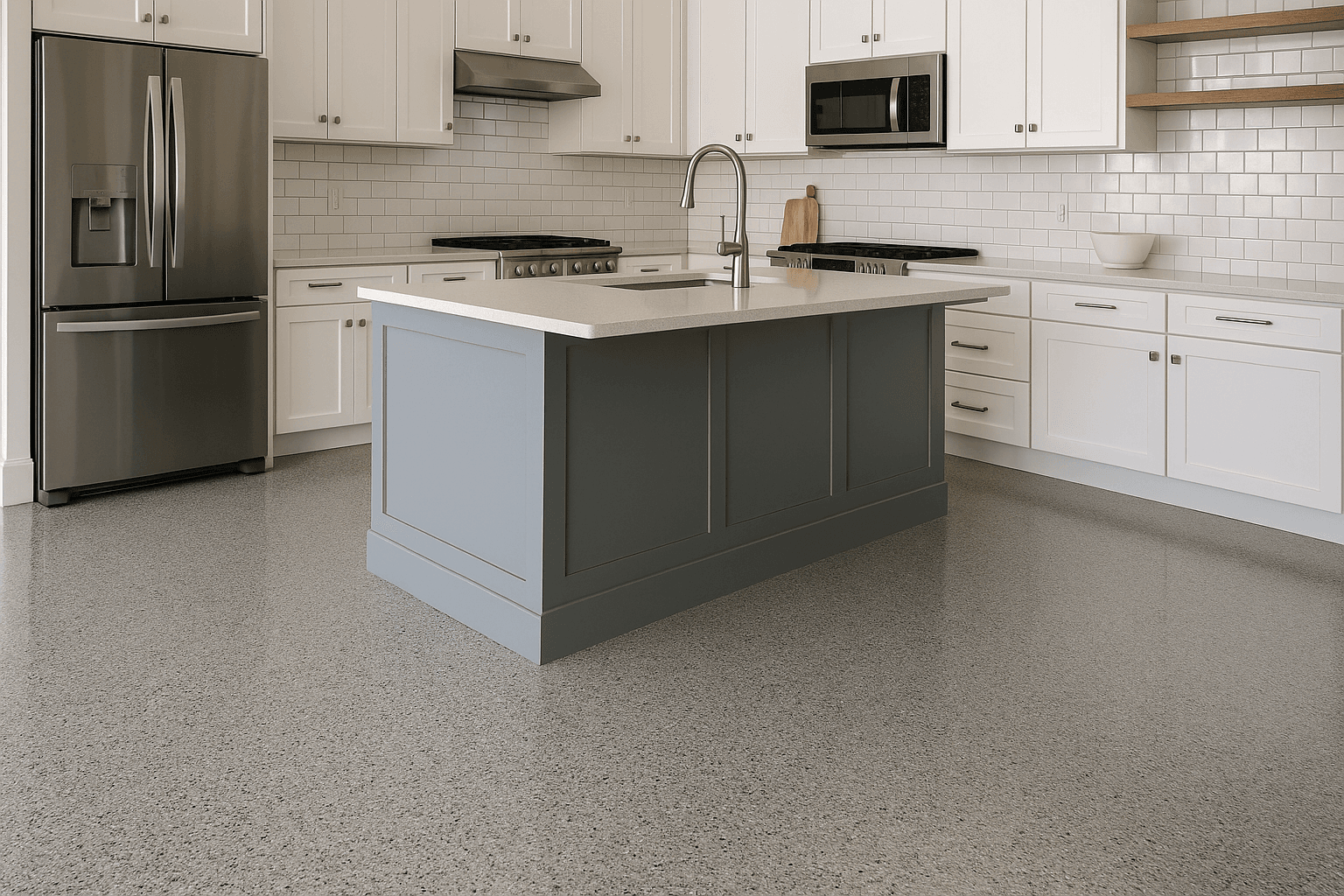
Your kitchen gets more footsteps, more chair scoots, and more “oops” moments than almost any other room. Tile can Chip and trap grime in grout lines; wood looks great but worries about water; vinyl can peel at seams near dishwashers. A kitchen epoxy flooring system changes the conversation. It’s a hard-wearing, non-porous surface with zero grout lines and a custom look—from soft, matte neutrals to glassy, high-gloss chef vibes.
Salt Lake homes run the style gamut: Sugar House bungalows love cozy, speckled Flake blends; modern Foothill builds lean Metallic and minimalist; busy Holladay families want easy-to-clean and slip-resistant. Epoxy covers all three without feeling “industrial.” Honestly, it’s flexible in a way most floors aren’t.
Why epoxy excels in kitchens
Toughness that just keeps going
We install 100% solids, professional-grade epoxy systems that stand up to daily knocks—dropped utensils, chair legs, pet zoomies, even the occasional cast-iron slip. Common stains like coffee, wine, turmeric, and oil wipe up instead of soaking in. With the right topcoat—often a UV-stable polyaspartic or urethane—the surface resists scratches and holds color in sunny rooms.
Seamless and hygienic—no grime-trapping grout
Because an epoxy floor is poured, it’s seamless across the room. No joints. No grout. No micro-gaps where crumbs and moisture love to hide. That’s a big deal for home cooks and a must-have for many commercial kitchens. When we add a coved base (a smooth, curved transition up the wall), cleaning becomes mop-and-go. It’s easier to sanitize and easier to keep looking new.
Tailored traction so it’s not slippery when wet
Shiny doesn’t have to mean slick. We can blend in fine traction additives—think aluminum oxide or silica—so the floor grips where it needs to, especially near sinks and dishwashers. Prefer a satin finish and extra texture? Easy. Want a glassy look with smart traction in work zones? Also doable. We tune the feel to your kitchen, your shoes, your routine.
Moisture and chemical resistance
Utah’s winters bring snow, salt, and slush, which somehow find their way to the kitchen. Epoxy systems resist road salts, common cleaning chemicals, and water. For concrete that has elevated moisture, we recommend testing and, if needed, installing a moisture vapor barrier primer to lock things down. That’s the unglamorous step that dramatically extends floor life—especially in older SLC homes.
The look: from homey to high-gloss pro kitchen
Epoxy isn’t a one-look material. It’s a design toolkit. We can go soft and subtle or bold and modern without sacrificing durability.
- Solid Colors that calm a space. Warm grays, creamy taupes, inky charcoals—timeless, easy to pair with cabinets and backsplashes.
- Decorative flake blends. A speckled, stone-like finish that hides crumbs and adds gentle movement. Great for families and rentals.
- Quartz systems. Textured, high-traction, color-consistent. A favorite in restaurants and busy home kitchens.
- Metallic epoxy. Swirled depth and a soft shimmer—beautiful for open-concept homes. Think “Artisan chef meets modern loft.”
- Matte to high-gloss. We control sheen with the topcoat, from low-luster practicality to Showroom shine.
If you’re pairing with wood in the living room or stone in the entry, we’ll suggest transitions that feel intentional—clean reducers, color-coordinated thresholds, or subtle height adjustments for smooth flow.
Utah weather, altitude, and why install quality matters
Salt Lake City’s altitude and swings in temperature affect curing times and how materials behave. Epoxy’s “pot life” shortens at higher elevation; humidity and cold can slow cures. That’s our problem to solve, not yours. We plan the install with heaters, airflow, and product selection that fits the season—low-odor, 100% solids epoxies and fast-curing polyaspartics when the schedule is tight. Winter kitchen? No problem. We can stage the space, protect nearby rooms, and keep the house comfortable while coatings cure.
And yes, we mind the little things: masking toe-kicks, protecting stainless appliances, sealing off returns so dust stays out of your HVAC. A cleaner install makes a better floor.
Epoxy vs. tile vs. luxury vinyl: a quick comparison
Different kitchens, different needs. Here’s a simple side-by-side.
| Feature | Epoxy Coating | Porcelain Tile |
|---|---|---|
| Seams/Grout | Seamless, no grout lines | Grout needs sealing, stains over time |
| Cleanability | Wipes clean, non-porous | Good, but grout holds grime |
| Impact/Drop Resistance | High with proper system | Can chip or crack |
| Slip Resistance | Customizable texture | Depends on tile, can be slick when wet |
| Aesthetics | Solid, flake, quartz, metallic | Many styles, grout pattern fixed |
| Maintenance | Low; cleaning + occasional recoat | Grout cleaning, possible regrout |
Luxury vinyl is comfy underfoot and cost-effective, but seams can lift near moisture and heat. If you cook a lot—or run a commercial kitchen—seamless epoxy often wins for hygiene and longevity.
Safety and indoor air quality
We use professional, low-VOC systems suitable for occupied homes. Once cured, an epoxy floor is inert and food-safe for normal kitchen use. During installation, we control airflow and isolate the work zone so you’re not living with odor. For households with sensitive noses, we schedule steps to minimize disruption. It’s a few days of planning for years of easier cleaning.
Concerned about warmth? If you’ve got radiant heat under the slab, epoxy works great over properly prepped concrete. It conducts heat well, so the floor still feels warm where the loops run.
What the installation actually looks like
Let me explain the Process, because the prep is where the magic is:
- Moisture testing if needed, especially in older homes. We want to know what the slab is doing.
- Concrete prep with diamond grinding or shot blasting to create a mechanical bond. This step separates pro installs from paint-and-hope jobs.
- Crack and joint repair with flexible or rigid fillers depending on movement.
- Primer, and if called for, a moisture vapor barrier primer.
- Basecoat of 100% solids epoxy; then your chosen style—flake broadcast, quartz, metallic swirl, or solid color.
- Topcoat in urethane or polyaspartic for UV resistance, scratch resistance, and the sheen you like.
Most home kitchens are walkable within 24 hours and ready for light use shortly after. Full cure varies by system—usually a couple of days for heavy appliances. We’ll guide you on when the fridge and range can roll back in.
Maintenance—short and sweet
This is the part people love. Because the surface is seamless and non-porous, regular care is easy:
- Daily/weekly: Dust mop or vacuum; damp mop with a pH-neutral cleaner.
- Spills: Wipe promptly; oils and sauces don’t soak in.
- Furniture: Felt pads on chair and stool feet keep things quiet and smooth.
- Abrasives: Skip harsh pads; microfiber and soft bristles work best.
- Refresh: Years down the line, a quick screen and recoat brings the sheen back without replacing the floor.
Small note: epoxy is tough, but not indestructible. Drop a cleaver point-first and you can mark anything. The difference is, damage can usually be repaired without ripping out the floor.
Common questions we hear in Salt Lake kitchens
Is it slippery? We tune texture to your space. Near sinks and dishwashers we usually add fine traction for a comfortable, grippy feel without looking “sandy.”
Will it yellow in sunny rooms? We use UV-stable topcoats for color retention. For very bright exposures, we recommend lighter, flake-forward or quartz systems that stay consistent over time.
Can you install over radiant heat? Yes—no problem. We manage slab temperature and cure schedules so the coating bonds correctly.
What about transitions to wood or tile? We set clean reducers and match heights. The finished look is intentional, not “patched.”
Is there a smell? During install, a mild odor is possible. We use low-VOC products and handle ventilation. Once cured, there’s no lingering smell.
Pets and claws? Pets are fine. Choose a satin topcoat or flake/quartz texture for the most scratch forgiveness.
For restaurants and commercial kitchens
We build coating systems for hospitality spaces across the valley—fast-cure schedules, heavy traction, and coved base that meets sanitary flooring needs. Quartz broadcast systems bang through wet zones; flake or solid color holds up in prep and service lines. Need slope-to-drain work or patching? We handle substrate repairs as part of the package, coordinate with your hood cleaners, and stage work so you can reopen on time.
Weekend turnaround is common: demo and prep Friday, system build Saturday/Sunday, reopen midweek depending on cure windows. We’ll be honest about realistic timing—no surprises.
Ballpark pricing along the Wasatch Front
Every project has variables—prep, moisture, design, cove base, square footage—but here are typical ranges for kitchen-sized areas in the Salt Lake City area:
- Solid color epoxy + urethane topcoat: about $7–$10 per sq ft
- Decorative flake system: about $8–$12 per sq ft
- Quartz broadcast system: about $9–$13 per sq ft
- Metallic epoxy: about $10–$14 per sq ft
- Moisture vapor barrier primer if needed: add ~$2–$4 per sq ft
- Coved base: priced per linear foot depending on height
Those numbers help with planning, but we always confirm after a quick site visit or photos. Older slabs with repairs or high moisture need extra steps; brand-new concrete might actually be simpler. Either way, you’ll get a clear, line-item Estimate from us before we start.
Why epoxy is the best choice for kitchens—quick recap
- Seamless hygiene: no grout, no hidden grime.
- Built for real life: stains, heat, impact—handled.
- Custom look: from low-luster calm to pro-grade shine.
- Safer footing: traction tuned to your work zones.
- Easy care: clean fast, recoat later, don’t replace.
If your kitchen is the heart of the home—or the engine of your business—epoxy floor coating gives you a surface that keeps up and looks great doing it. That combination is hard to beat.
Ready when you are
Thinking through colors during a remodel? Want a sanitary upgrade without tearing out tile? We’d love to help you map the right system, the right look, and the right timeline.
Call Utah Epoxy Coatings at 801-515-0892 or click below to Request a Free Quote. Tell us how you cook, how you clean, and what you want the room to feel like. We’ll bring samples, real-world advice, and a plan that makes your kitchen easier to live with—day in, day out.