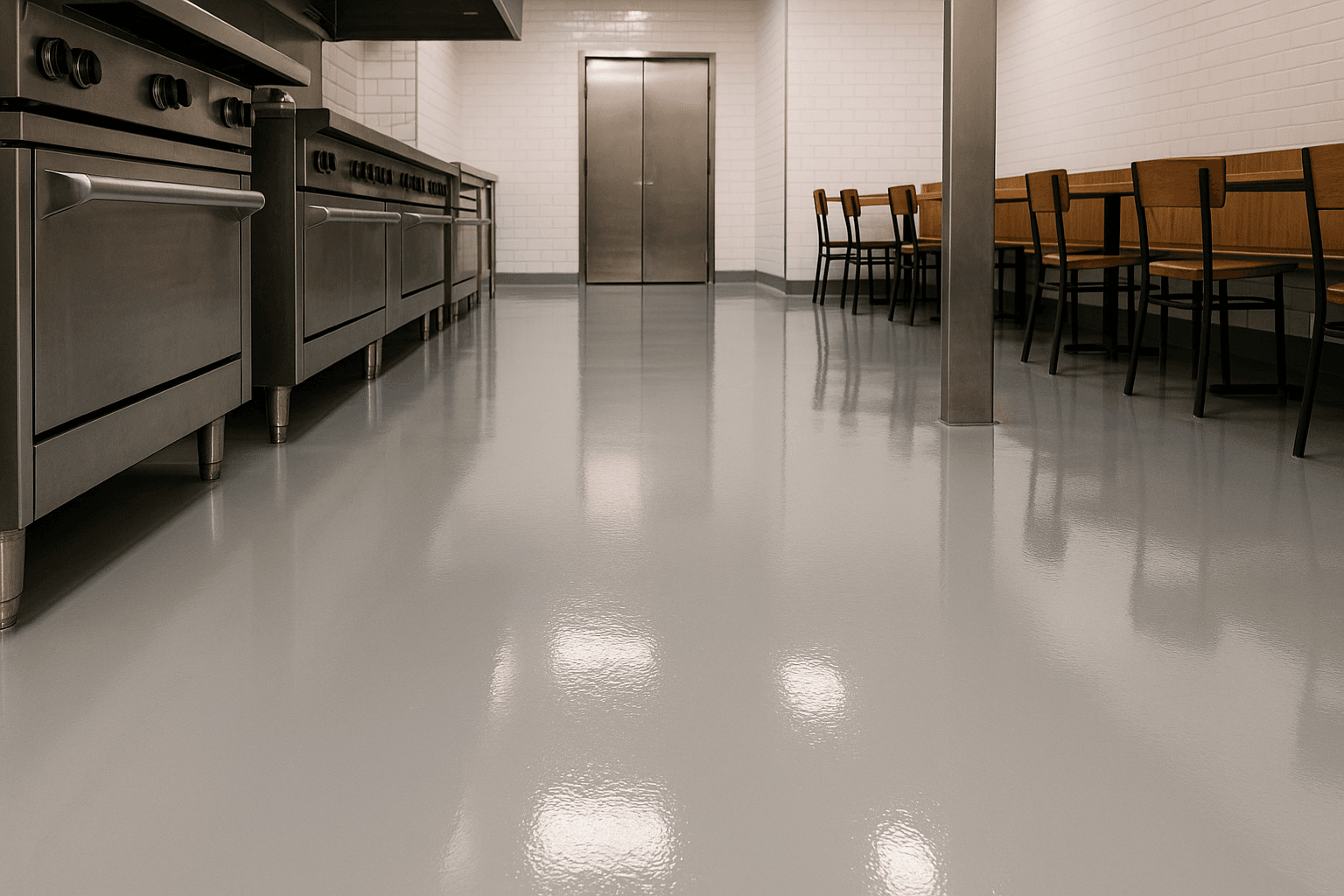
Restaurant floors take a beating—grease, heat, hot water, forks falling from the expo line, and a busy crew moving fast during dinner rush. That’s why a well-installed Epoxy Floor coating can feel like a miracle for a restaurant. It looks clean, resists spills, and helps your staff stay safer on their feet. If you’re in or around Salt Lake City, you’ve got added curveballs: snowmelt, de-icing salts, and big temperature swings. This guide walks you through a step-by-step Process tailored for restaurants—clear, practical, and honest about what works. And yes, we’ll talk about curing times and weekends, because service never stops.
Contents
- 1 Who this guide is really for
- 2 Different zones, different needs
- 3 Step 1: Assess the space and the rules
- 4 Step 2: Test the concrete (yes, you really should)
- 5 Step 3: Surface prep that makes coatings last
- 6 Step 4: Choose the right system (without overthinking it)
- 7 Step 5: Plan the schedule and route the crew
- 8 Step 6: Mixing and installing—how it actually goes down
- 9 Step 7: Weather and altitude quirks in Salt Lake
- 10 Step 8: Safety, odor, and food-safe practices
- 11 Step 9: Curing and return to service
- 12 Step 10: Cleaning and maintenance that extends life
- 13 Common mistakes to skip
- 14 What it costs in Salt Lake City
- 15 Why Utah Epoxy Coatings
- 16 Ready to talk? Let’s make your restaurant floor work harder
Who this guide is really for
This is for restaurant owners, franchise managers, chefs who also handle facilities (we see you), and even homeowners who want commercial-grade durability in their Garage or rec room. If you run a kitchen in Sugar House, a bar in the Granary District, or a café near City Creek, you’ll find this useful. You want a reliable, easy-to-clean surface that passes health inspections without drama. We’ll keep the jargon brief and the advice straightforward—while still giving you real-world detail.
Different zones, different needs
Not every part of a restaurant floor needs the same system. The front of house wants polish. The back of house wants toughness. Bathrooms need slip resistance. You know what? It’s normal to mix systems to get the best result.
| Area | Recommended System | Notes |
|---|---|---|
| Kitchen / Dish / Prep | Urethane cement base with Quartz broadcast and epoxy or polyaspartic topcoat | Handles hot water and thermal shock; build cove base at walls |
| Dining / Bar | 100% solids epoxy floor coating with decorative Flake or quartz, sealed with a clear topcoat | Good looks, easy cleaning; tune slip resistance for servers |
| Restrooms / Entry | Epoxy with anti-slip aggregate and chemical-resistant clear | Moisture and salts from winter boots; needs bite when wet |
Small contradiction, big truth: epoxy is tough, yet it doesn’t love sudden heat shock. That’s why we often pair epoxy with urethane cement in kitchens. More on that in a bit.
Step 1: Assess the space and the rules
Here’s the thing—before any coating goes down, you want to check the basics. Are there positive slopes to drains? Do you need a cove base up the walls for health inspections? Are there expansion joints near the cookline that move with the slab?
What we check in Utah restaurants:
- Health code details: Cove base (4 to 6 inches), smooth and cleanable surfaces, no pinholes or pores where grease can sit.
- Slip resistance: Kitchens usually need a more aggressive profile than dining; think R11–R12 in kitchen, R9–R10 for the dining area.
- Drains and thresholds: Stainless clamping drains, consistent transitions to tile or concrete at the back door.
- Thermal shock zones: Near dish machines and fryers; that’s where urethane cement shines.
Let me explain: inspectors care about cleanability. Cove base at the walls lets you hose and squeegee without gunk living in corners. It’s simple, but it’s a big deal.
Step 2: Test the concrete (yes, you really should)
Most restaurant failures start with moisture. Salt Lake’s older buildings—especially in neighborhoods like Marmalade or along State Street—sometimes lack a proper vapor barrier. That moisture can push up and cause blisters under the coating.
We run moisture tests like:
- ASTM F2170 (in-slab RH): Checks relative humidity inside the concrete.
- ASTM F1869 (calcium chloride): Measures Moisture Vapor Emission Rate.
- pH tests: High pH can mess with adhesion; we neutralize as needed.
Found elevated moisture? Not the end of the story. We install moisture mitigation primers such as Sika MB, Ardex MC Rapid, or MAPEI Planiseal EMB. They create a barrier so your epoxy floor coating stays bonded.
Step 3: Surface prep that makes coatings last
Good prep is the unglamorous hero. Without it, nothing sticks. We create the right profile with shot blasting or diamond grinding (Husqvarna/HTC, Blastrac, or Metabo setups) and use HEPA dust extraction for a clean, safe space.
Typical prep steps:
- Degreasing: Hot alkaline cleaners pull oil out. In heavy spots, we poultice or torch-wash and test again.
- Crack and joint repair: Fill with fast-set polyurea or epoxy gel; re-cut control joints after cure.
- Profile creation: CSP 2–4 for coatings; CSP 5–7 for urethane cement or repair areas.
- Edge work: Under equipment legs and along baseboards—no shiny untouched stripes.
It might feel like overkill. It isn’t. Prep is the difference between a 1-year floor and a 10-year floor.
Step 4: Choose the right system (without overthinking it)
We’ll keep it simple. You want durability, cleanability, and the right slip rating. The recipe changes by zone, but the logic stays the same.
Common systems we install around Salt Lake City:
- Kitchen: Urethane cement base for heat and water shock, full quartz broadcast for grip, then a chemical-resistant clear. Cove base along walls and behind equipment.
- Dining/Bar: 100% solids epoxy floor coating with colored quartz or decorative flake (Torginol is a favorite), sealed with polyaspartic topcoat for scratch resistance.
- Restrooms: Epoxy with an extra pass of anti-slip aggregate such as aluminum oxide or 3M grit.
Want extra chemical resistance for pickling or sour beers? A novolac epoxy topcoat adds bite against acids. Prefer a satin look? We’ll choose the right clear, so it’s not slick but still easy to mop.
Small contradiction we promised to explain: epoxy is the star, yet in hot, wet zones, urethane cement is the backbone. The two play well together, and together they win in restaurants.
Step 5: Plan the schedule and route the crew
You can’t close for a week. We get it. We often phase projects—kitchen first, dining second—or run a weekend blitz with extended crew hours. Cure times matter, so timing is everything.
What we plan around:
- Temperature: Ideal installation around 65–75°F; we can heat or cool zones if needed.
- Ventilation: Even low-odor, 100% solids epoxy needs airflow for comfort.
- Staging: Move equipment, cap drains, protect walls, post caution signs.
- Cure windows: Primers, body coats, and clears each have a recoat time. We time it tight but safe.
Honestly, the best money you’ll never see is in planning. It saves you stress and keeps service rolling.
Step 6: Mixing and installing—how it actually goes down
Primer coat
We mix Part A and Part B with a slow-speed drill and Jiffy blade, then pour in ribbons and backroll. Primer wets the concrete and grabs dust you can’t even see. It also helps block pinholes.
Body coat with texture
Next, a thicker 100% solids epoxy or urethane cement base for kitchens. While it’s wet, we broadcast quartz or flake to rejection—like seeding a snow path on a Wasatch morning. That texture boosts slip resistance.
Cove base
We trowel a 4–6 inch cove where the floor meets walls. Smooth radius, no seams to trap grease. Health inspectors love it because cleaning gets easy.
Scrape and seal
After the broadcast cures, we scrape and vacuum loose media, then seal with one or two clear coats. For front-of-house, a polyaspartic topcoat keeps abrasion down and cleans up like a champ. Around dish areas, we pick a clear that stands up to hot water and soap.
We keep film thickness on target, usually 20–40 mils combined depending on zone. Thin coatings look fine but don’t hold up to carts and kegs. We build the system to the life you need.
Step 7: Weather and altitude quirks in Salt Lake
Utah’s dry air helps cure times, but hot/cold swings can mess with pot life. Summer installs set faster; winter installs need heat to avoid dew point issues. We watch slab temperature, not just air temp.
Two quick tips:
- Winter: Keep doors closed and heat steady. Snowmelt salts come in on shoes—cover entries during install.
- Summer: Mix smaller batches. Pot life shrinks when it’s warm, and rushing leads to roller lines.
It’s not rocket science. It is attention to detail.
Step 8: Safety, odor, and food-safe practices
We’re big on safety. The crew wears gloves, eye protection, and respirators when needed. We isolate food contact areas, cover prep tables, and run negative air if the layout calls for it.
To keep the restaurant staff comfortable, we use low-odor, low-VOC materials. Many systems are NSF/USDA-compliant for incidental food contact and approved for commercial food prep zones. If you’ve got sensitive schedules—brunch rush, late-night service—we’ll phase the work so smells don’t mingle with soufflés.
Step 9: Curing and return to service
Here’s the timeline most restaurants follow:
- Light foot traffic: 12–24 hours after final coat, depending on temperature.
- Heavy equipment: 48–72 hours—let’s be honest, 72 is safer for casters and loaded walk-ins.
- Chemical resistance: Full cure in 5–7 days. Don’t shock the floor with harsh degreasers before that.
We’ll map your opening and deliveries around this so you’re not guessing. And yes, we’ll put down protection if the beer distributor insists on rolling in early.
Step 10: Cleaning and maintenance that extends life
Commercial epoxy flooring is easy to clean, but the right routine makes it last much longer. Daily wet mop or auto-scrub with a neutral to mildly alkaline cleaner keeps grease from building up. Avoid citrus solvents and super-hot steam directly on epoxy in the dining area—they can haze the finish over time.
Useful habits:
- Auto-scrubber: A Tennant or Advance machine with soft pads is fantastic for dining rooms.
- Degreaser rotation: Use a food-service safe alkaline cleaner weekly in kitchens, then rinse well.
- Mat control: Catch mats at entries; wash them often so they don’t grind grit into the floor.
- Refresh coats: If gloss dulls or aggressiveness fades, a quick re-topcoat brings it right back.
One odd tip: keep chair glides in good shape. Little details save big money.
Common mistakes to skip
A few things we see all the time:
- Skipping moisture tests: Looks fine at first, then blisters appear. Test, then treat.
- Under-prepping: Polishing the concrete instead of profiling it. Shiny isn’t better here.
- Wrong texture: Too smooth in kitchens, too rough in dining. Calibrate it to your staff’s reality.
- Thin coats: You save a little now, pay a lot later.
- No cove base: Health inspectors will call it out, and cleaning gets harder without it.
You might feel tempted to rush. That’s the only thing we won’t do.
What it costs in Salt Lake City
We’ll shoot you straight with ballpark numbers. Actual pricing depends on prep, moisture work, and layout, but these ranges help with planning.
Typical ranges we see:
- Dining / Bar: 6–12 per sq ft for a quality epoxy floor coating with decorative flake or quartz and a clear topcoat.
- Kitchens: 10–18 per sq ft for urethane cement with full quartz and a high-build clear, including cove base.
- Repairs / Moisture control: Add-on depending on slab condition and vapor readings.
For context, that’s competitive with heavy-duty tile without the grout headaches. Plus, the seamless surface cleans faster and looks sharp on those kitchen tours chefs love giving.
Why Utah Epoxy Coatings
We’re local. We know Wasatch winters and the weird humidity pockets by the Great Salt Lake. Our crews use proven systems from brands like Sherwin-Williams General Polymers, Sika, Dur-A-Flex, and Tnemec, and we match the product to your space—not the other way around.
We’ll help you plan around service, install cove where you need it, tune the slip resistance so servers move with confidence, and set you up with a cleaning plan. You get a floor that looks good on opening night and still looks good when Patio season ends.
You know what? A good restaurant floor fades into the background. Staff move better, customers feel the cleanliness, and you stop thinking about repairs. That’s what we build.
Ready to talk? Let’s make your restaurant floor work harder
If you’re considering Salt Lake City epoxy floors for your restaurant—or you want help choosing between epoxy and urethane cement in the kitchen—Utah Epoxy Coatings is here to help. We’ll look at your space, test the slab, and map out a plan that fits your schedule.
Call us at 801-515-0892“>801-515-0892 or Request a Free Quote. We’ll make it easy, clear, and built to last.