Picture your Patio on a summer night in Salt Lake City. The grill’s sizzling, the Wasatch glow hits just right, and people flow from kitchen to backyard. Now imagine that same patio floor—clean, seamless, and tough enough for snow shovels and salsa spills. That’s the promise of a well-installed epoxy patio coating. It’s not just about looks. It’s about a surface that works hard without feeling like it’s trying. You know what? For Utah weather, that matters.
Contents
- 1 Epoxy patio coating, explained like a neighbor
- 2 Is epoxy actually good for outdoor patios in Utah?
- 3 What you get day to day: the real-life benefits
- 4 Style choices that actually work outside
- 5 Traction and safety: keep it comfortable, not crunchy
- 6 Prep is everything: the un-glamorous step that makes coatings last
- 7 What installation day looks like
- 8 Costs in Salt Lake City: straight talk and ballpark numbers
- 9 Maintenance: five-minute routines that actually stick
- 10 DIY vs hiring a pro: honest pros and cons
- 11 Common questions we hear in Salt Lake City
- 12 Why Utah Epoxy Coatings?
- 13 Timing your project around Utah weather
- 14 A quick word for businesses
- 15 Ready when you are: schedule a no-pressure consult
Epoxy patio coating, explained like a neighbor
At its core, an epoxy patio coating is a two-part resin system. A resin meets a hardener, and the mix cures into a Solid, dense layer bonded to concrete. Think of it like a clear, tough shield—only you can tint it, add color chips, or upgrade the top layer for extra protection.
Epoxy isn’t paint. Paint sits on top and wears thin. Epoxy chemically fuses to the concrete. It’s thicker, tougher, and more forgiving with day-to-day life. Most outdoor systems for Patios layer components: a penetrating primer, a body coat (often with color flakes or Quartz), and a UV-stable topcoat that protects the whole system from sun and abrasion.
And yes, that topcoat makes all the difference outside. More on that in a second.
Is epoxy actually good for outdoor patios in Utah?
Short answer: yes—when it’s designed for sun, snow, and our altitude. Regular indoor epoxies can yellow in UV, and they get chalky over time. Salt Lake’s elevation and bright summers speed that up.
Here’s the thing. The right system for an outdoor patio in Utah usually pairs epoxy or polyurea as the base with a UV-stable topcoat like aliphatic urethane or polyaspartic. That combo gives you strong adhesion on the concrete plus excellent UV resistance. It also stands up to freeze–thaw cycles, which can be brutal when a warm day turns icy after sunset. We see it every spring in Sugar House and Sandy—patios with hairline cracks from those quick temp swings.
De-icing salts? They’re tough on bare concrete. A protected surface—especially a Flake or quartz epoxy for outdoor patios—helps resist salt, moisture, and stains. It won’t make winter easy, but it’ll make winter kinder to your slab.
What you get day to day: the real-life benefits
Let me explain what homeowners and businesses actually notice.
- Easy cleaning. Dust from the lake bed, spilled drinks, muddy dogs—everything sweeps and rinses off faster.
- Durability. Dense, chemical-resistant surfaces shrug off oil, grease, and grill residue. They don’t mind patio furniture sliding around.
- Better looking spaces. A crisp, even finish pulls the whole area together. It’s subtle, yet it stands out.
- Weather-savvy performance. With the right build, your patio resists UV, salt, and freeze–thaw stress.
- Custom traction. Add fine texture for grip without turning the floor into sandpaper.
Sound simple? It is. That’s the point.
Style choices that actually work outside
Outdoor Finishes need to be smart and attractive. The good news: you have range.
- Solid color epoxy. Clean, modern, and easy to match to stucco or trim. Great for businesses that want a tidy patio or entry.
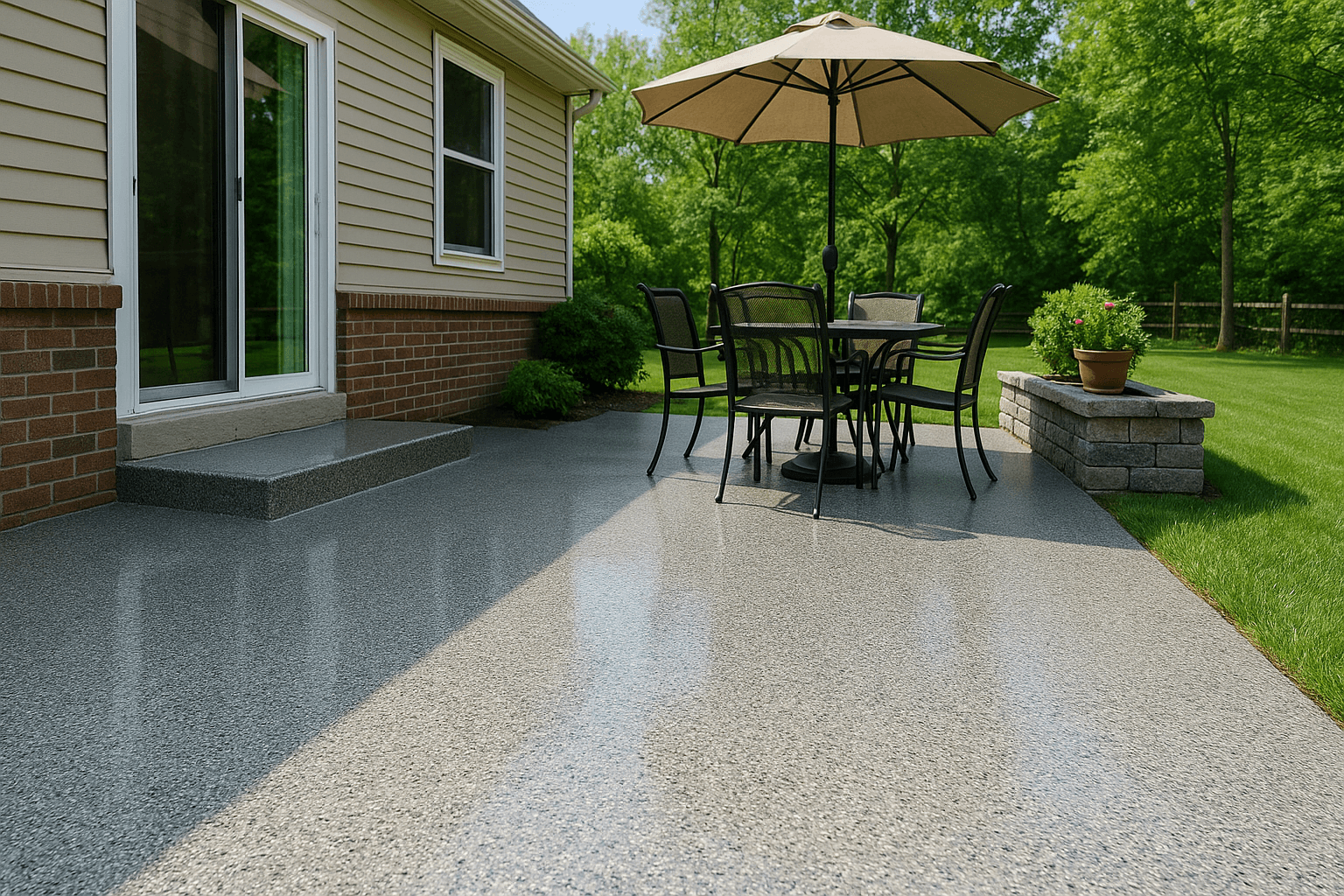
- Color flake systems. The classic epoxy flake system hides dust and dirt between cleanings. It’s popular in Daybreak because it pairs well with light landscaping and xeriscape designs.
- Quartz broadcast. Small, colored quartz granules create a uniform, textured look with excellent traction. Good choice for Pool surrounds or shaded patios that stay damp.
- Patterns and borders. You can define zones around seating, fire pits, or grills with subtle color changes.
One note: Metallic epoxies are beautiful inside, but they aren’t the best fit outdoors because of intense UV. If you’re after shimmer, we’ll coach you toward finishes that age gracefully in the sun.
HOA to consider? We work with many along the Wasatch Front and can recommend color blends that pass review.
Traction and safety: keep it comfortable, not crunchy
Wet patio, smooth shoes, fast step—no thanks. Slippery isn’t our style. We tune texture with additives like silica, aluminum oxide, or polymer grit. Each has a different feel under foot.
Quartz and full flake systems naturally add texture. If you want a smooth look with more grip, we blend a fine traction additive into the UV-stable topcoat. It’s barely noticeable but helps when snowmelt or sprinkler overspray hits the surface.
Quick rule of thumb: families with kids, dogs, or a pool nearby usually prefer a light to moderate texture. Restaurants and commercial patios often go a notch higher for safety without making cleanup a pain.
Prep is everything: the un-glamorous step that makes coatings last
It’s a little funny—people talk about Colors and chips, but the make-or-break moment is the surface prep. We clean, degrease, and mechanically grind the concrete with diamond tooling to a concrete surface profile (CSP) around 2–3. That creates a texture epoxy can grab. Shot blasting can be used for older or sealed slabs.
Moisture matters, too. Patios can wick moisture from the ground. We check with tools like Tramex concrete meters or calcium chloride kits. If readings run high, we use a moisture-mitigating primer rated for higher vapor drive.
Cracks and spalls get repaired with fast-setting repair mortars. Control joints can be honored or filled depending on slab movement. We also look at drainage—water should run away from the house. If the slope isn’t right, we’ll discuss options before coating.
Edges, stairs, and posts? Those tricky areas get detailed so the system looks seamless, not “patched around.”
What installation day looks like
Most residential patios wrap up in one to two days, weather depending. Commercial spaces can go faster with fast-cure materials.
Typical flow:
- Day 1. Grind and prep, repairs, moisture-friendly primer, base coat, and broadcast of chips or quartz.
- Day 2. Scrape excess chips, vacuum, then apply the UV-stable topcoat for protection and gloss level you want.
Foot traffic is often okay within 12–24 hours. Heavier furniture returns after 48–72 hours. Light Utah spring? Great. Mid-winter? We can sometimes heat-tent smaller areas, but we’ll be honest if Mother Nature says “not today.” Most coatings like to cure above 50°F and away from rain or blowing dust.
Costs in Salt Lake City: straight talk and ballpark numbers
Every patio is different, but we know everyone wants a range. Here’s a helpful snapshot for the SLC area. Keep in mind size, repairs, moisture, and design details can shift the numbers.
| System | Typical Price per sq ft | Notes |
|---|---|---|
| Solid color epoxy + urethane | $6–$9 | Clean look, light texture available |
| Full flake system + UV topcoat | $7–$12 | Great traction, hides dust and dirt |
| Quartz broadcast + UV topcoat | $8–$14 | High traction, uniform texture |
As a fast example, a 350 sq ft patio in Millcreek with moderate prep and a full flake system might land around $2,800–$3,800. Bigger areas can bring the price per foot down. Repairs or moisture treatments may add cost, but they also add lifespan. That’s money well spent.
We back our work with clear warranties tailored to the system. Ask us about our coverage for peeling, yellowing, and wear—no vague language, just real terms.
Maintenance: five-minute routines that actually stick
Keeping your coated patio clean is easy. A broom or leaf blower handles dust. A hose rinse and mild detergent lifts grease or pollen. For tougher spots, use a soft nylon brush. Skip harsh acids or stiff wire brushes, and limit pressure-washer force to gentle settings to protect the texture.
After big winter storms, rinse away de-icing salts when temps rise. In spring, check furniture foot pads and grill casters. Little details help keep that slip-resistant patio looking crisp for years.
DIY vs hiring a pro: honest pros and cons
We’ll say it up front: DIY kits exist. Some folks even enjoy the challenge. But patios can surprise you. Moisture vapor, old sealer, and hidden cracks aren’t obvious until you start grinding. If you have a diamond grinder with proper dust control, a HEPA vac, and experience with two-part coatings, DIY might be on the table for a small slab.
Most homeowners and businesses call us because they want a predictable result with a UV-stable topcoat that won’t amber, proper texture, and a smooth finish at edges and posts. We run into patios where someone skipped grinding, and the coating lifted by spring. It’s fixable, but it costs more than getting it right the first time.
Tools we use: planetary grinders with diamond segments, Tramex moisture meters, Torginol flakes, and premium topcoats from brands like Sherwin-Williams Resuflor, Tennant, and LATICRETE SPARTACOTE. The gear matters. So does the crew.
Common questions we hear in Salt Lake City
Will my patio yellow in the sun?
Not with the right system. Standard epoxies can amber. We use a UV-stable topcoat like aliphatic urethane or polyaspartic to resist yellowing and chalking.
How slippery is it when wet?
We tune the grip for you. Flake and quartz give natural texture. For smooth looks, we blend fine traction into the topcoat so you get control without a gritty feel.
What about winter? Can I shovel it?
Yes. Use plastic shovels or rubber blades to preserve the finish. Avoid metal tips that can gouge. Rinse salt when you can.
How long does it last?
With proper prep and a good system, many patios go 8–12 years before needing a refresh. Sun exposure, foot traffic, and maintenance all play roles.
Can you match my Garage floor?
Absolutely. We’re known for cohesive garage and patio coatings across a property. It ties everything together—nice touch for resale, too.
Why Utah Epoxy Coatings?
We’re local, and we’re a little picky about prep. Our team works across the valley—from Foothill to Herriman—and we’ve seen every slab quirk Utah throws at us. High UV? We counter it. Freeze–thaw? We plan for it. Inversion dust? We seal against it. It’s not magic; it’s repetition, and it’s care.
We recommend systems that make sense for you, not just what’s on a shelf. If a quartz broadcast is smarter than a slick finish for your north-facing patio, we’ll say so. If your concrete shows moisture spikes, we’ll test it and use primers that can handle it. Simple, clear, and focused on your patio.
Our crews are trained, tidy, and on time. That last part feels small until it isn’t.
Timing your project around Utah weather
Spring and fall are usually the sweet spot: mild temps and less chance of pop-up storms. Summer works, too, with early start times and fast-cure topcoats. Winter is possible for covered or tented areas, but we’ll always confirm temperatures and dew points before scheduling. Coatings like consistency; we respect that.
A quick word for businesses
For restaurants, cafés, and office patios, a clean, non-porous surface pays for itself. Faster cleanup between tables, fewer stains, and better durability under chair legs and foot traffic. We often recommend full flake with a satin UV-stable topcoat: professional look, tough as nails, not too shiny in bright sun. If you’ve got brand colors, we can build them into the finish without going loud.
Ready when you are: schedule a no-pressure consult
Patios should be easy to love. If you want a surface that looks sharp, holds up to Utah weather, and cleans up fast, we’d be happy to help. Utah Epoxy Coatings installs Salt Lake City epoxy floors and patio systems built for our climate, our seasons, and your style.
Call us at 801-515-0892 or tap below to start a friendly, straightforward Process—no hard sell, no guesswork.