Laundry rooms work hard. Water splashes. Detergent drips. Machines shake. And somehow the floor is supposed to handle all of it without staining, cracking, or getting slick. That’s a tall order—unless you give it a surface built for real life. If you’ve been eyeing a new floor for your laundry space, Epoxy Floor coating might be the quiet hero you’ve been waiting for. It looks clean, handles spills like a champ, and makes the whole room feel brighter and easier to keep tidy. You know what? It even helps on those chaotic “sports uniforms plus muddy socks” days we all pretend we enjoy.
Why Laundry Rooms Need Tough Floors (Especially Here in Salt Lake City)
Let’s be honest: laundry rooms don’t get the same love as kitchens or baths, but they see just as much action. In Salt Lake City, we track in snowmelt, road salt, and red dirt from trail days. Then there’s Utah’s hard water, which can leave a filmy residue on concrete and tile. Add a humming washer, a dryer that runs hot, and occasional leaks or overflows, and the floor gets a daily stress test.
Concrete alone is porous and dusty. Tile grout stains and cracks. Sheet vinyl feels thin and can curl at edges. That’s why a seamless, chemical-resistant, and easy-to-clean surface helps—not just for looks, but for safety and sanity. A laundry room epoxy floor won’t blink at water, bleach, or fabric softener. And that matters on a Tuesday night when the washer decides it’s auditioning for a jazz band and vibrates across the room.
What Exactly Is Epoxy Floor Coating?
Here’s the thing: epoxy flooring isn’t “paint.” It’s a two-part system. One part resin, one part hardener. When mixed, they crosslink, turning into a dense, hard-wearing surface that bonds to your concrete. Think of it like a well-made quilt but for your floor—layers stitched together so they act as one tough piece.
Most laundry rooms do great with a pigmented epoxy base coat and a protective topcoat. If there’s extra moisture in the slab (common in basements), we use a moisture-tolerant primer first. Have lots of sunlight in the room? We can add a UV-stable urethane topcoat to keep Colors true. There are also slip-resistant additives and decorative Flake or Quartz blends that add texture and grip. It’s practical, but it also looks sharp.
Why Epoxy Shines In Laundry Rooms
Let me explain why homeowners and small businesses around Salt Lake City keep choosing this surface for utility spaces.
- Water and spill resistance — Epoxy forms a tight, non-porous film. Spilled bleach? No drama. Leaky hose? Wipe and move on. It’s often called “waterproof”—well, technically the coating resists water and stops absorption, which is the point.
- Chemical toughness — Detergents, softeners, spot removers, and even a little acetone from a nail polish mishap won’t etch or stain quality epoxy.
- Durability under vibration — Washers and dryers rumble. Epoxy stands up to abrasion and impact, and it won’t shed dust like raw concrete.
- Seamless and easy to clean — No grout lines. No dirt traps. A microfiber mop and a neutral cleaner keep it like-new.
- Slip-resistant options — We can build in texture with flake or quartz, or add a fine traction additive. Safer feet in wet moments.
- Brighter space — Epoxy floors reflect light, which helps in basements or rooms with small windows. It’s subtle, but it makes folding less gloomy.
- Looks that match your home — From soft gray with light flake to a bold quartz blend, laundry rooms don’t have to be, well, dull.
Bonus note: if your laundry room is near a Garage entry, epoxy handles the winter salt tracked in from the driveway. That stuff can wreck tile grout. Epoxy shrugs it off.
Common Concerns, Straight Answers
We hear the same questions, so let’s tackle them quickly.
- “Is it slippery?” — Smooth epoxy can be, just like tile. We add traction so it feels secure even when damp. Texture can be subtle or more grippy—you choose.
- “Will it smell?” — Professional-grade epoxies we use are low-VOC. There’s a mild odor during install and cure, but it dissipates fast with ventilation.
- “Does epoxy yellow?” — Direct UV can amber some epoxies over time. In sunny rooms, we finish with a UV-stable urethane topcoat to keep color steady.
- “How long does it last?” — With normal laundry-room use and simple care, many years. If it ever needs a refresh, we can re-topcoat without redoing the whole system.
- “What about flood risk?” — Epoxy doesn’t swell like vinyl or wick like grout. If a big leak happens, dry the room out and you’re usually fine.
Epoxy vs. Other Laundry Room Floors
Picking Finishes can get messy. Here’s a simple side-by-side to help you compare.
| Solid #ddd; padding:8px;”>Flooring | Pros | Considerations |
|---|---|---|
| Epoxy/Flake System | Seamless, chemical-resistant, easy cleaning, traction options, bright look | Needs proper prep and cure; add UV-stable topcoat for sunny rooms |
| Porcelain Tile | Hard-wearing tile surface; many styles | Grout stains/cracks; slippery when wet; harder to clean |
| Sheet Vinyl/LVP | Budget-friendly; soft underfoot; quick install | Seams and edges can lift; chemicals can stain; not great with heavy vibration |
| Sealed Concrete | Low cost; industrial vibe | Still porous; needs frequent re-sealing; dusting and staining happen |
Short version: if you want a clean, strong, low-fuss surface that stays that way, epoxy floor coating checks the boxes.
Local Know-How: What Sets Utah Epoxy Coatings Apart
We’re locals. We get Wasatch Front winters, summer heat, and how basements in Sugar House aren’t quite the same as new builds in Daybreak. That’s why our Process leans on prep and moisture awareness.
- Professional surface prep — Diamond grinding with HEPA dust control (Husqvarna/Metabo systems) to open the concrete and ensure a strong bond.
- Moisture testing — RH probes per ASTM F2170 and MVER checks. If readings are high, we use a moisture-tolerant primer or epoxy vapor barrier (Mapei Planiseal, Ardex MC kits) before color coats.
- Crack and joint repair — Fast-cure polyurea and epoxy mortar repair for a flatter, tighter finish.
- Optional cove base — A small epoxy cove at the wall edge keeps mop water and spills from sneaking behind baseboards.
- Topcoats for the room — Urethane or polyaspartic topcoats for UV and abrasion protection where it makes sense.
We match the system to your space, not the other way around. It’s still quick and tidy, but the details matter—especially in utility rooms that see a little of everything.
Design Ideas That Make Laundry Less Boring
Utility spaces can be friendly. A few favorites we’ve installed around Salt Lake City:
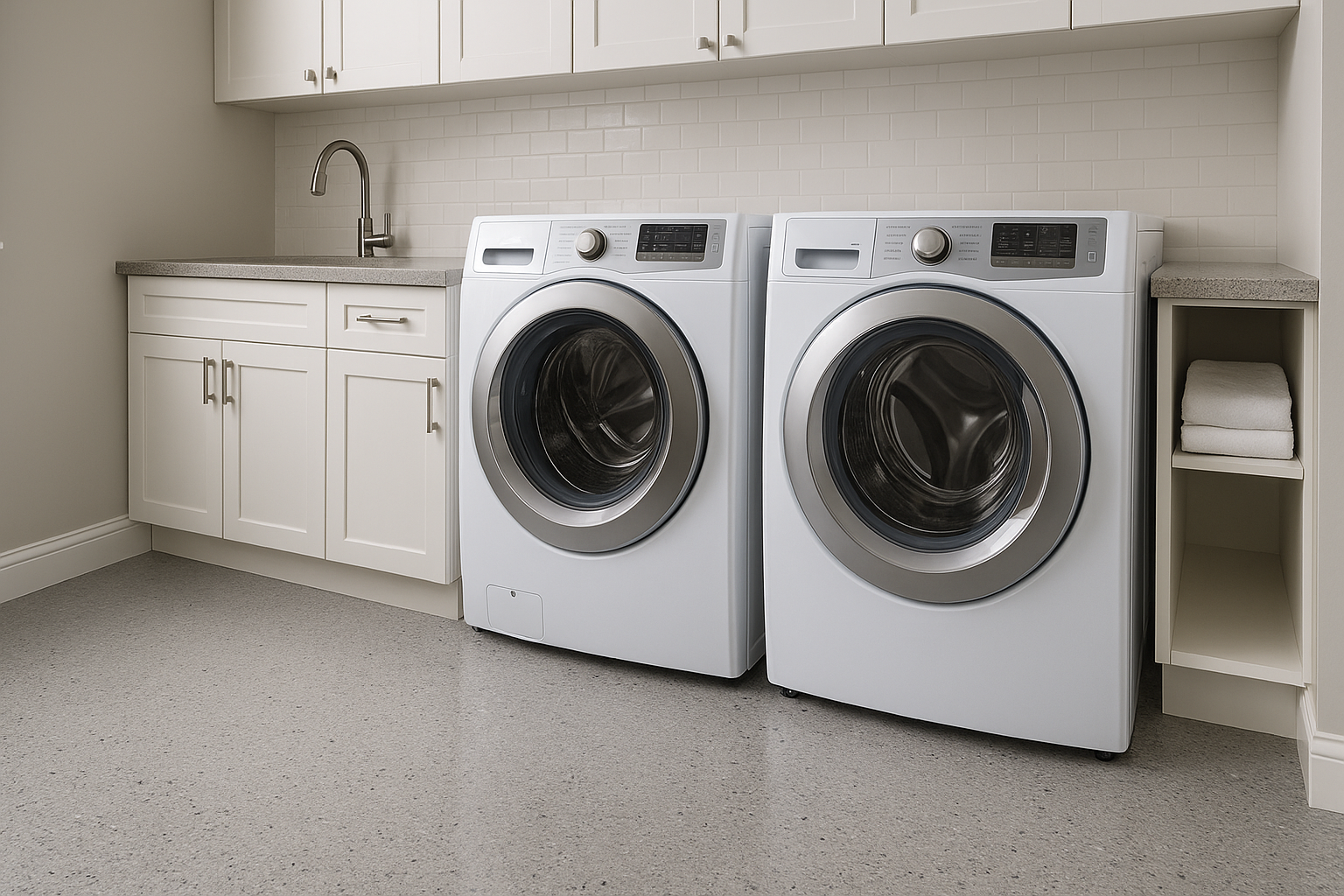
- Soft gray with light flake — Hides lint and dust between cleanings; looks modern and clean.
- Quartz broadcast in warm neutrals — Subtle sparkle, better traction, and a premium feel without trying too hard.
- Solid color with satin topcoat — Minimalist and bright. Great for small rooms you want to feel bigger.
- Accent edge or cove — A slight color contrast at the perimeter can frame the room and look custom.
Metallic epoxy? Gorgeous, but in a laundry room it can be overkill. Still want a little drama? We can add a soft metallic veil or choose a flake blend with a hint of shimmer.
How the Installation Works (Smooth, Fast, Clean)
A typical laundry room install takes one to two days on site, plus cure time. Timing depends on size, condition of the slab, and the system we choose.
- Day 1 — Move appliances, mask edges, diamond grind the slab, repair cracks, and apply primer/base coat. If you’re doing flake or quartz, we broadcast it now.
- Day 2 — Scrape excess flake, vacuum, then apply the protective topcoat. We keep dust down and odors minimal with good ventilation.
Light foot traffic is often okay within 12–24 hours depending on product and temperature. Heavy loads like washers and dryers usually go back after 24–48 hours. We’ll advise based on the exact system so you don’t rush it. Honestly, giving it that extra half day can make all the difference for a bulletproof finish.
Care and Maintenance: Easy, Really
You don’t need fancy products or a strict schedule to keep epoxy flooring looking sharp. A few habits help:
- Regular dust mopping — A microfiber mop or soft broom handles lint and dust.
- Neutral cleaner — Use a pH-neutral product like Zep Neutral pH or Simple Green diluted per label. Rinse if needed.
- Protect points of contact — Anti-vibration pads under appliances reduce noise and scuffing. Felt pads under utility tables or baskets help too.
- Avoid harsh acids — Vinegar won’t ruin it, but repeated strong acids may dull the sheen. Stick with neutral cleaners and you’re golden.
If, after years, the topcoat loses a bit of its gloss, we can lightly abrade and re-topcoat. It’s like a tune-up, not a rebuild.
FAQs We Get from SLC Homeowners
Can you coat over my painted or sealed concrete?
Yes—with prep. We remove failing layers and grind to reach sound substrate. Then we build the system so it bonds like it should.
What if my basement slab has moisture?
We test first. Moderate moisture is fine with a moisture-tolerant primer. Higher readings may call for an epoxy vapor barrier. We’ll explain options and costs up front.
Is it okay over radiant heat?
Yep. Epoxy systems perform well over hydronic radiant slabs. We just confirm the floor’s cool during install and follow cure temps.
How do you handle floor drains or slopes?
We honor existing drainage. Need a small feathered slope to a drain? We can build it with epoxy mortar before coating.
What about smell and pets?
Low-VOC products and active ventilation keep odors light. We’ll suggest keeping pets out of the room until the surface is cured to the touch.
What It Costs in Real Life
Every space is different, but small laundry rooms around Salt Lake City often fall into a friendly price range because the footprint is tight. As a ballpark, you might expect:
- Basic solid-color epoxy with traction — Typically in the low to mid range per square foot, with a small-area minimum.
- Flake or quartz systems with urethane topcoat — Slightly higher per square foot; still very reasonable given the long life and low upkeep.
Repairs, moisture barriers, and cove base add a bit, but we’ll separate each line item so you can choose what fits your goals and budget. No guesswork. No surprises. Just a clean, tough floor that earns its keep.
A Quick Reality Check: Is Epoxy Always the Answer?
Mostly, yes for laundry rooms. If you love tile patterns, tile can still be right—you’ll just be cleaning grout more often. If you move appliances a lot, epoxy’s seamless finish saves you from tearing edges. And if you want set-it-and-forget-it maintenance, epoxy is hard to beat. It’s the low-drama choice that still looks good. That said, we’ll tell you if your slab needs extra steps before coating. Better to be clear now than fix it later.
Ready to Make Laundry Day Easier?
Imagine walking into a brighter, cleaner laundry room that stands up to spills, salt, and spin cycles without fuss. That’s the promise of a well-done epoxy floor coating—and it’s what we install every week across the Salt Lake Valley.
Let’s talk about your space, your colors, and your timeline. Call 801-515-0892 or Request a Free Quote and we’ll set up a quick, friendly consult. No pressure—just clear answers, a fair price, and a floor that works as hard as you do.
Utah Epoxy Coatings installs laundry-room epoxy systems in Salt Lake City, Millcreek, Holladay, Sandy, West Jordan, South Jordan, Draper, and nearby communities. We’ll bring the samples. You bring the wish list. Sound good?