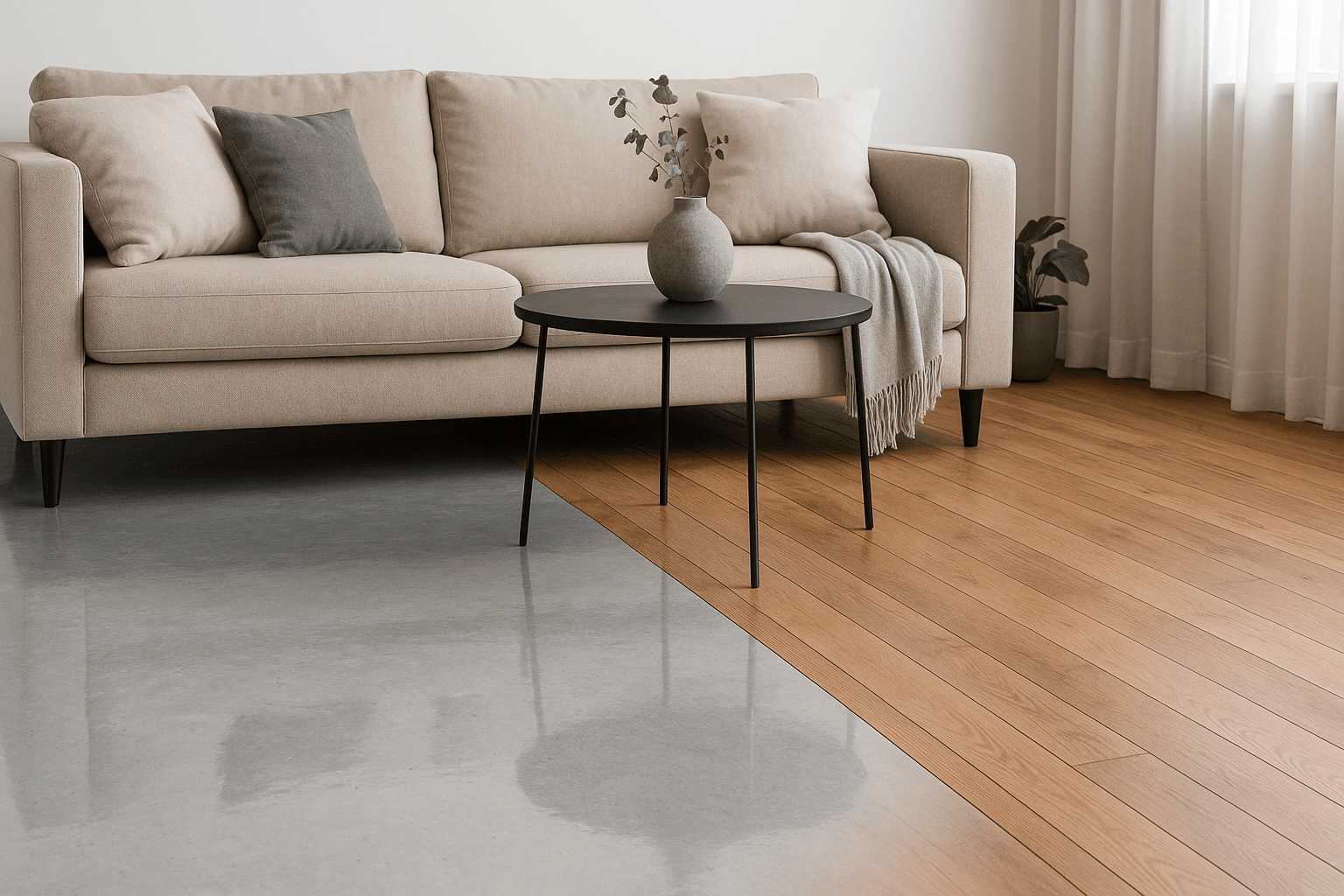
Your living room works hard. It hosts movie nights, pet zoomies, game days, and the quiet hours when the Wasatch Range turns pink and you finally exhale. So the floor? It needs to look great and take a beating—without constant babysitting. That’s why more Salt Lake City homeowners are asking a simple question: should we go with epoxy flooring in the living room, or stick with traditional flooring like wood, carpet, or tile? Here’s the thing: both can be fantastic. They just shine in different ways. Let me explain, and I’ll keep it simple, honest, and local.
So… what is living room epoxy, really?
Epoxy flooring is a two-part resin system that bonds to concrete and cures into a seamless surface. It’s tough, spill-resistant, and customizable. And it’s not just “Garage gray.” In a living room, epoxy can look like polished stone, soft terrazzo, or even a swirling Metallic finish that plays with the sunlight we get at our higher elevation.
We install decorative Flake blends for texture and warmth, sleek metallics for a modern vibe, and Quartz systems for serious durability. Want it glossy? Sure. Prefer a softer matte epoxy topcoat that won’t glare near those big Sugar House windows? Even better. We also use low-VOC or zero-VOC options, so your home smells like home, not a project site.
You know what? People often assume epoxy is cold and “industrial.” That was true back when options were limited. Today’s residential systems pair beautifully with area rugs, earthy palettes, and natural wood furnishings. It’s a fresh, clean canvas—right under your feet.
Traditional floors at a glance
Traditional flooring covers a lot: Solid and engineered hardwood, carpet, luxury vinyl plank (LVP), tile, and even polished concrete. Each has a personality.
Hardwood feels classic and warm. Carpet softens sound and adds coziness. LVP shrugs off spills and mimics the look of wood for less. Tile gives you cool elegance and radiant-heat compatibility. If your home leans Craftsman or mid-century, traditional may match your bones and your taste.
But SLC living has its quirks: tracked-in road salt, spring mud, canyon dust, pets that act like mountain goats. The floor that wins is the one you don’t have to fret over.
A quick side-by-side (the need-to-know stuff)
| Factor | Epoxy Flooring | Traditional Flooring |
|---|---|---|
| Durability | High; resists stains, scuffs, dropped toys | Varies; hardwood can dent, carpet stains, tile is hard but grout stains |
| Maintenance | Easy; mop and mild cleaner | Regular vacuuming; refinishing or steam-cleaning may be needed |
| Comfort | Firm underfoot; add rugs for warmth | Carpet is soft; wood warmer; tile cool |
| Design Range | Huge; flake, metallic, quartz, satin or gloss | Huge; species, stains, weaves, plank widths, tile sizes |
| Spill Resistance | Excellent; non-porous and seamless | Good to poor; wood swells, carpet absorbs, grout stains |
| Pet-Friendly | Very; easy cleanup and scratch resistant | Carpet traps hair; wood scratches; LVP holds up well |
| Install Time | ~1–3 days in most homes | ~1–5 days depending on type and prep |
Durability for real life (kids, pets, and Salt Lake grit)
Utah winters bring slush, sand, and road salt—your foyer does its best, but a little always sneaks into the living room. Epoxy flooring in Salt Lake City handles that grit better than wood or carpet. There’s no grain to scratch, no fibers to cling to the mess, and no grout lines to absorb the dirty melt.
Hardwood is timeless, but chair legs and dog nails can leave their mark. Carpet offers cushion, but it doesn’t love coffee, salsa, or the arts-and-crafts glitter phase. Tile is tough, though dropped dishes may crack the surface and the grout demands care. Epoxy isn’t invincible—dragging a piano without sliders can scuff any surface—but it holds up. And touch-ups are more straightforward than refinishing your whole living room.
Small detail, big result: We use abrasion-resistant topcoats—often a polyaspartic finish from brands like Spartacote or Sherwin-Williams General Polymers—so the surface resists scuffs and UV more than basic hardware-store kits.
Comfort, warmth, and sound—does epoxy pass the couch test?
Here’s the mild contradiction you’re probably thinking: epoxy is beautiful, but isn’t it cold and echoey? True—by itself, it’s firm and slightly cooler than wood. But pair it with a thick area rug and a good rug pad, and your living room turns cozy fast. Add radiant heat and it becomes a dream. Epoxy conducts warmth evenly, so if you’ve got hydronic tubes or plan to add electric radiant, epoxy plays well with both.
As for acoustics, hard floors reflect sound. You can tame that with layered textiles: curtains, upholstered furniture, bookshelves, and those strategic rugs (a 9×12 under the sofa usually does wonders). Many modern SLC builds are bright and open; a soft-finish epoxy with micro-flakes and a matte topcoat also reduces glare and a bit of echo.
Design: from mountain-modern to minimal
With living room epoxy, style is where it gets fun. Think subtle “terrazzo” flake blends like our locally-loved Wasatch Gray or Parleys Taupe—earthy, modern, timeless. Or go bold with metallics that swirl like storm clouds over the Great Salt Lake. Want the softness of stone with the cleanability of a seamless floor? We can do that with layered pigments and a satin topcoat.
Traditional floors also shine here. Walnut plank can set a stunning mood. Wide-oak engineered boards lend warmth that’s hard to beat. If your home is a 9th & 9th bungalow with original trim, rich wood might feel just right. That’s okay. Flooring is also about the soul of the house. Epoxy is incredible for clean, modern interiors, busy households, and anyone craving low maintenance. Wood, carpet, and tile serve different kinds of comfort.
Cleaning and everyday care
Epoxy living rooms are easy. Sweep or vacuum. Mop with a neutral cleaner. Spills wipe up. Red wine doesn’t taunt you. Craft paint? Wipe it before it sets. There are no seams where crumbs hide, and pet hair collects in neat little piles that your vacuum loves.
Carpet needs regular vacuuming and occasional deep cleaning. Tile needs grout care; sealing helps. Hardwood needs a careful cleaner and, eventually, refinishing. LVP is low-maintenance too—though seams can still trap grit, and sharp objects can gouge it. For households that entertain a lot, epoxy and LVP save time. Epoxy wins on stain resistance and long-term polish.
Safety and indoor air quality in Utah homes
We’re serious about IAQ and chemistry. Our systems include low-odor, low-VOC or zero-VOC epoxy and high-performance polyaspartic topcoats. Cure times are fast, and the smell fades quickly. If someone in your household is sensitive, we’ll schedule for good ventilation and use products designed for healthier homes.
Another concern you might have heard about: UV yellowing. Older epoxies could amber in strong sunlight. At our altitude, the sun hits harder. That’s why we specify UV-stable topcoats. A polyaspartic sealer with UV inhibitors keeps color true, even in rooms with big windows and that gorgeous afternoon glow.
Slip resistance matters, especially with kids or wet winters. We can add a light texture—almost invisible—to reduce slip while keeping a clean, living-room look. Think safety without the sandpaper feel.
Cost and timeline in Salt Lake City
Numbers help. Here’s a straightforward snapshot for the SLC area. Final pricing depends on size, prep, and design, but these are solid ballparks.
- Epoxy (decorative flake or satin metallic): usually $5–$12 per sq. ft. installed
- Hardwood (installed and finished): about $8–$18+ per sq. ft.
- Engineered wood: about $6–$14 per sq. ft.
- Carpet: about $3–$7 per sq. ft.
- LVP: about $3–$8 per sq. ft.
- Tile: about $7–$20 per sq. ft.
Timeline? A typical living room epoxy install takes 1–3 days depending on moisture levels, crack repair, design layers, and cure time. You’ll move furniture out, we’ll grind the surface for a perfect bond, repair imperfections, prime, build color, and finish with a protective topcoat. Then we set a simple timeline for foot traffic and furniture reset. Often, light foot traffic returns within 24 hours, with furniture back in 48–72 hours. Easy.
When epoxy is a smart pick
- Busy households: Kids, pets, parties—no stress over spills or scuffs.
- Open, modern layouts: Seamless floors make spaces feel bigger and calmer.
- Allergy concerns: No fibers; easy dust control.
- Radiant heat plans: Epoxy conducts warmth beautifully.
- Sunny rooms: UV-stable topcoats keep color true.
- Salt, snow, and mud: Track it in, wipe it up, done.
When traditional wins
- Historic character: You’re preserving an original Craftsman look.
- Soft, plush feel: Carpet-first households who love barefoot cushion.
- The wood story: You adore patina and don’t mind refinishing in a decade.
- Acoustic priorities: You want the quietest room possible with minimal textiles.
A quick neighborhood story
We finished a living room in Sugar House for a young family with a big golden retriever. They were tired of constant carpet cleaning after winter walks and summer hikes up Millcreek. We installed a soft-gray flake blend with a satin topcoat, then they layered a wool rug under the sectional. Two months later, they told us the floor looks brand-new and they mop in five minutes, tops. The dog? He naps in the sunny patch by the window, no slipping, no scratches. That’s the daily life test—passed.
Common questions we hear
Will epoxy make my living room feel like a garage? Not with modern Finishes. We use decorative blends and low-gloss topcoats that read warm and residential. Think modern loft, not service bay.
Can you install epoxy over wood or tile? Usually we want a stable, rigid base. Over concrete is ideal. Over tile, we can grind and prep if the substrate is sound. Over wood, we typically add a cementitious underlayment or go a different route. We’ll evaluate and give you straight answers.
Is epoxy cold? It’s firm, like tile. With rugs and radiant, it’s cozy. And it stays stable through our dry winters and hot summers.
How long does it last? A quality system with proper prep can run 10–20 years in a living room. When it needs a refresh, we can sand and re-topcoat rather than pulling everything out.
Does it scratch? Any floor can. Epoxy with a premium topcoat resists everyday wear and cleans up fast. Furniture pads and felt sliders are still smart.
Our Process at Utah Epoxy Coatings
We keep it professional but friendly—straight talk and clean installs.
- Consultation: We measure, check moisture, and learn how you live in the space.
- Surface prep: Diamond grinding for a strong bond. Moisture mitigation if needed.
- Repairs: Crack bridging and patching so your finish is smooth and strong.
- Primer + body coats: We build color, depth, or flake texture to your design.
- Topcoat: UV-stable polyaspartic in gloss, satin, or matte for durability and style.
- Walkthrough: We share care tips and a simple maintenance plan.
We work with proven systems from respected manufacturers, and we stand behind our craftsmanship. Honestly, that’s non-negotiable for us.
So… which is best for your living room?
If you want a sleek, tough, low-maintenance floor that handles SLC’s seasons and still looks designer, epoxy flooring is a standout. If you want the patina of natural wood or the hush of wall-to-wall carpet, traditional flooring still wins hearts. Both are “right.” The best one is the one that fits your home, your habits, and your taste—without becoming another chore on your list.
You know what? You don’t have to figure it out alone. We’ll help you weigh style, budget, and daily life, then recommend what’s honestly best for you. That’s how we’d want someone to guide our own homes.
Talk with Utah Epoxy Coatings
Thinking about living room epoxy in Salt Lake City—or still on the fence? Let’s chat. We’ll bring samples, share real homes, and map a plan that fits your space.
Call 801-515-0892 or click Request a Free Quote. We’ll make the decision feel easy—and your living room feel right.